
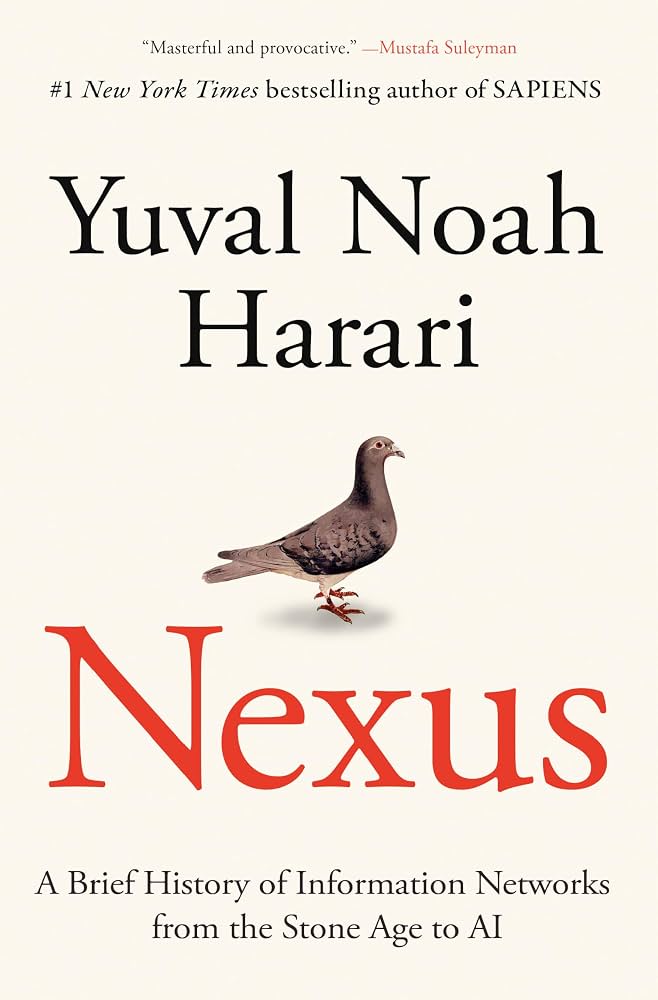
Nexus: A Brief History of Information Networks from the Stone Age to AI by Yuval Noah Harari
The author of this book is Yuval Harari, an Israeli historian and professor at Hebrew University, famous for Sapiens, Homo Deus, and 21 Lessons for the 21st Century. While his previous works covered the past, future, and present of humanity, this time he seeks to re-examine human history from the perspective of information networks and glimpse into its future.
Harari begins by defining information, stating that stories are the first information networks. In Harari’s view of information, it is closer to a context that connects various nodes to induce a certain kind of interconnectedness; here, he argues that the view that information equates to truth is very naive, stating that in fact, information is almost always unrelated to the truth.
The information technology that bound people together after stories was writing and documents. This was highly revolutionary because it enabled the storage of vast amounts of information beyond human memory and its transmission across generations. In fact, the system of bureaucracy also emerged from the need for searching due to the development of documents. This seemed to open up another possibility: infallible information technology. The early founders of Judaism, Christianity, and Islam believed that if they transcribed the great word of God onto paper and created millions of copies, no one would be able to distort it, and thus the path to absolute truth had finally opened.
However, in reality, this was not the case. Regardless of whether the word of God was truly infallible and consistent, even if it were transcribed accurately letter by letter, the problem of interpretation remained. For example, when there is a command not to work on the Sabbath, exactly what is defined as work? Ultimately, the role of determining this fell back to human institutions.
However, even if the task of managing and supervising information networks was entrusted to human institutions, which are inherently prone to error, not all information networks were the same. Harari views information networks as situated somewhere on the opposing spectrum of decentralization and centralization, stating that the quality of a network varies depending on how the flow of information is organized.
For example, democracy is a prime example of a decentralized information processing network. As many decisions as possible are made freely at the local level, and even important decisions that everyone must follow must undergo global network consensus. Conversely, totalitarianism is the epitome of a centralized network. In totalitarianism, the central authority decides everything. Individual citizens or other institutions have no choice but to simply follow orders.
Another crucial factor determining the quality of an information network is the existence of self-correcting mechanisms. For example, in a democratic society, the media and academia monitor the government, the government and the media monitor academia, and the media is also monitored by the government and academia. When corruption or errors occur among them, they actively report them and correct them. In contrast, such a series of mechanisms does not exist in a totalitarian society. Both the media and academia merely represent the government’s position, and there is no such thing as mutual surveillance.
Harari sheds light on the present and future, not just the past. Are our information networks handing over their power to algorithms? Harari says yes. Today, various social media platforms are important channels for information distribution. And these channels are operated by algorithms that are highly specialized for a single goal. Controlling information networks has always been at the center of power since the birth of the press. For instance, figures such as Benito Mussolini, the Italian dictator and founder of fascism, and Lenin of the Soviet Union were both former newspaper editors. Therefore, Harari’s diagnosis that our power is shifting to algorithms is truly incisive.
Finally, discussing computer politics, Harari states that artificial intelligence can create a completely new kind of reality. This is “intercomputer reality,” following objective reality, subjective reality, and intersubjective reality. Unlike other animals, the human species was able to become the rulers of the Earth after the cognitive revolution 70,000 years ago by acquiring a new layer called intersubjective reality. However, what would happen to us if a being with a reality one level higher than humans were to emerge? Yuval Harari concludes the book by answering this question. I hope you enjoy reading it.
Reviewed by Teen Volunteer, 6/18/2026.