
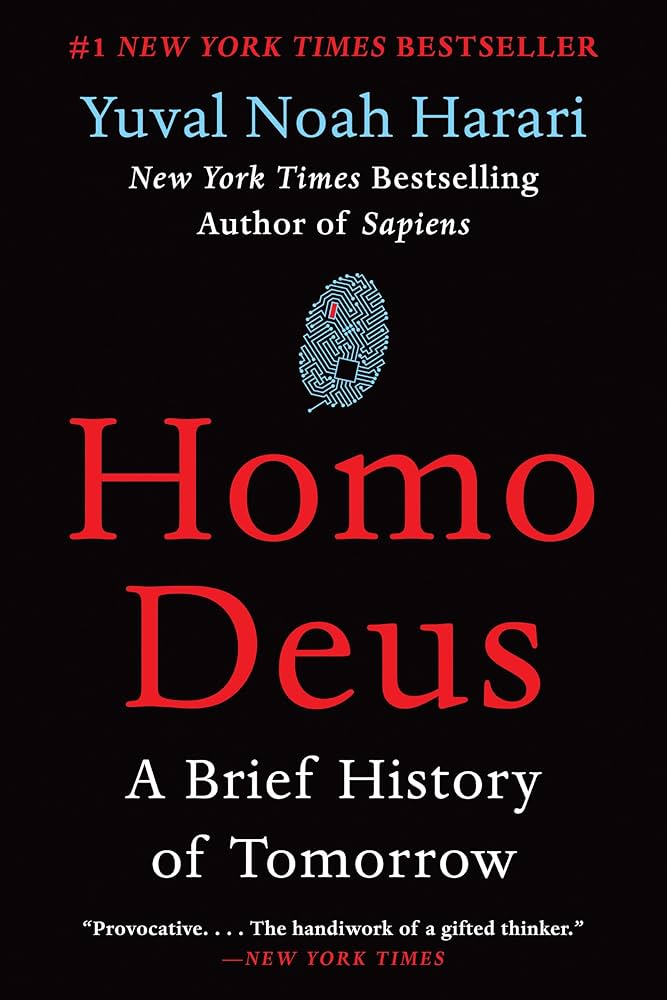
Homo Deus: A Brief History of Tomorrow by Yuval Noah Harari
This book is by Yuval Harari, a historian and Hebrew University professor best known as the author of Sapiens. It can essentially be described as a new version focusing on the future briefly mentioned at the end of Sapiens.
Harari begins by reminding us that humanity has come to conquer the world. We have gone beyond merely occupying a piece of the Earth’s ecosystem puzzle to becoming the first biological organisms to actively drive ecological change. We connect two continents separated by less than a day’s time difference and have herded organisms that would never have otherwise met into the same place. (Of course, such behavior has become much more restricted recently compared to the past, but the reality is that even at this very moment, microorganisms, viruses, small insects, and even marine creatures like starfish and crabs are traveling the world with us, attached to airplanes and ships.) As a result, we have become the first species to successfully integrate various fragments of the world that were once far apart.
This current world is so advanced that it would not be an exaggeration to call it the Anthropocene. We did not stop there. As storytellers, we created narratives capable of interpreting our own circumstances whenever the times changed, and ultimately succeeded in creating a value system called humanism, thereby denying God and ascending to the position of the source of value. Considering that this occurred simultaneously with the “contract of modernity”—gaining the power of science in exchange for denying a creative world filled with transcendent meaning—human achievement is simply shocking. However, this era of humanity may soon come to an end.
The time bomb of this age, which will bring our philosophical golden age to a close, does not lie in the minds of philosophers or in the daily sermons of church priests. They exist in our laboratories. Shockingly, modern science has increasingly revealed that human feelings and desires (the core of humanism) are not transcendent at all. Our selves are not fundamentally quantized, nor are the emotions or feelings we experience mysterious at all.
For now, we are prolonging our golden age by isolating this time bomb in the laboratory from everyday beliefs, philosophical thought, or the fundamental propositions of political philosophy. However, we cannot do so forever. Such scientific advancements will eventually elevate humans to the status of Homo Deus, possessing eternal youth, immense ability, and power; however, the moment we ascend to that position, we may for the first time relinquish the divinity of being the source of value from a philosophical perspective and become blind beings who do not know what to do. When that time comes, we may have no choice but to follow the dynamics of data and technology.
Reviewed by Teen Volunteer, 5/30/2026.